GTA 6 feels like Florida because Rockstar built a living place
GTA 6’s Leonida feels like Florida because Rockstar combines field research, recognizable locations and deeply authored NPCs instead of relying on landmarks alone.
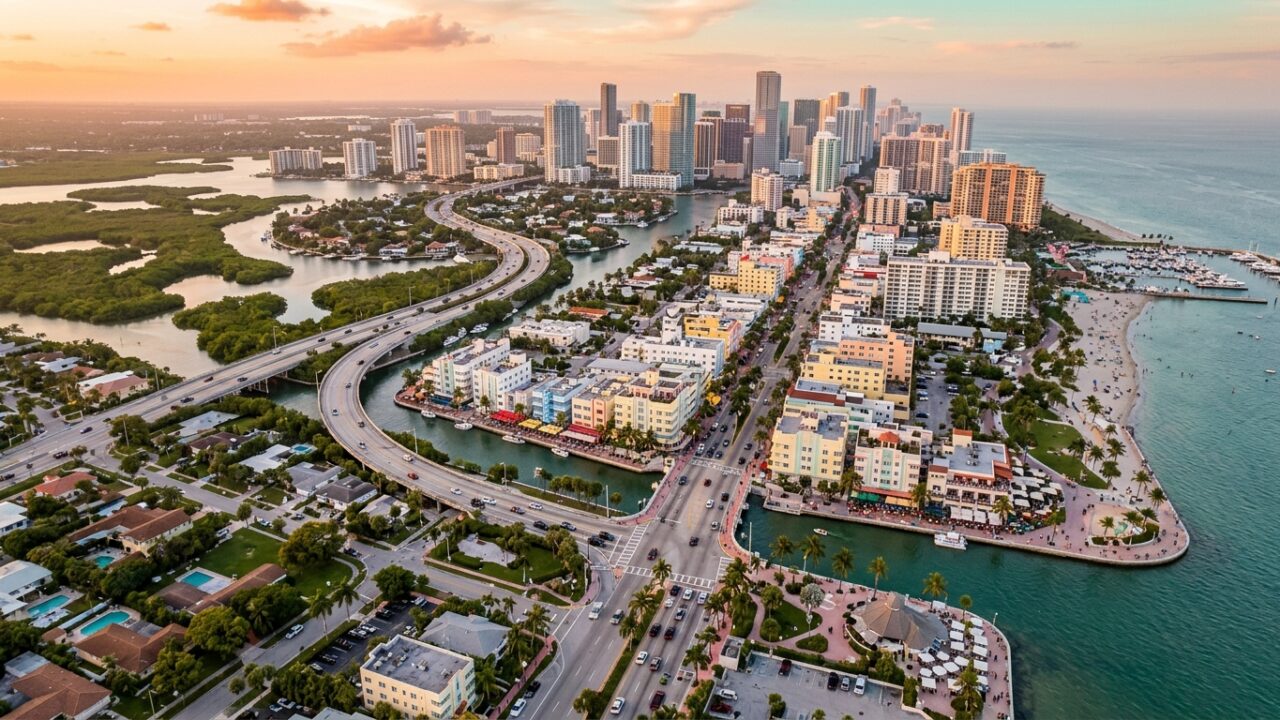
Grand Theft Auto 6 (GTA 6) feels like Florida because Rockstar built Leonida from recognizable systems, landmarks and everyday behavior rather than treating Vice City as a collection of visual set pieces. The game’s fictional state is rooted in Miami, the Florida Keys and wetlands, while its characters, interiors and background activity supply the detail that makes those places feel occupied.
The result is not a one-to-one digital copy of Florida. It is a compressed interpretation that uses selected details to trigger recognition. That distinction matters: the realism comes less from matching every street than from combining enough familiar geography, architecture, transport and social behavior to create a convincing sense of place.
Rockstar started with the setting
According to The Verge, Rockstar producer Rob Nelson said the development team visited Florida before production, including the Everglades, the Keys and urban areas. The Architect’s Newspaper separately reported that the team’s 2015 research included Miami, police ride-alongs, flights over wetlands and visits to Florida bars. Both accounts describe the setting as the starting point, with the story and characters developed afterward.
Rockstar’s own GTA 6 website presents the result as a state-wide story in Leonida, rather than a game confined to Vice City. Its official material identifies Vice City as the central location and describes a criminal conspiracy stretching across Leonida. The company’s screenshot archive also separates locations including the Leonida Keys, Port Gellhorn, Grassrivers and Mount Kalaga National Park. Together, those materials establish the design baseline: a fictional state assembled from multiple Florida environments, not simply a remake of Miami.
Why the details work
The clearest independent evidence concerns the world’s people and buildings. IGN reported that GTA 6 contains more than 100 explorable interiors and that Rockstar created detailed backstories for many locations and non-player characters, even when players only see fragments of them. The same report describes field research involving Keys helicopter trips, police ride-alongs, conversations and photography. Those systems give the scenery context: a building is not only an exterior model, and a pedestrian is not only moving decoration.
Polygon’s post-launch reporting shows how that approach translates into recognizable references. The outlet identified adaptations of Miami locations including the Adrienne Arsht Center, E11EVEN, the Miami Marine Stadium and the Clevelander. It also noted that players were comparing in-game locations with real Florida buildings, including less famous apartment complexes. That is a useful change from a landmark-only recreation: recognition can happen through ordinary architecture as well as tourist icons.
This article’s analysis is that Leonida’s realism works in layers. Rockstar supplies the broad geographic contrast; field research supplies local visual and cultural reference; and the NPC and interior systems supply continuity at street level. The limit is equally important: The Verge’s Emma Fraser noted that the game omits ordinary urban features such as schools and daycares and is not geographically complete. GTA 6 therefore feels like Florida through carefully chosen snapshots and implied scale, not because it reproduces the state in full.
Discuss in the forum
What do you think about this story? Start the discussion in our forum.
Discuss in the forum →